Where is it?
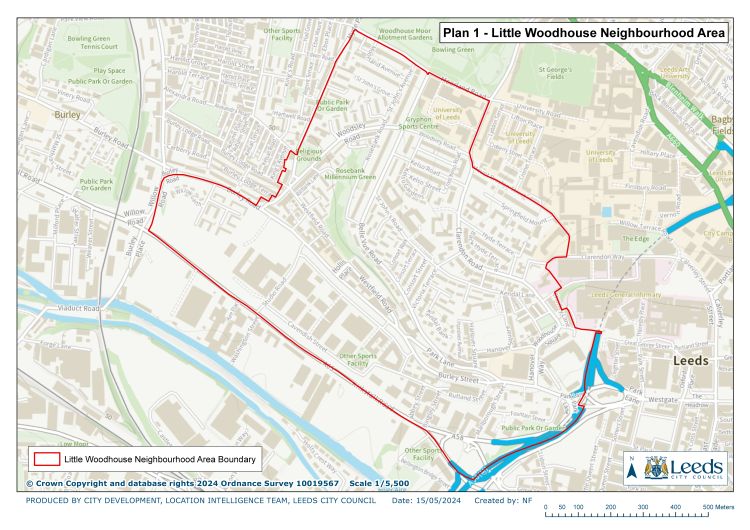
Little Woodhouse is a mainly residential area which just dips its eastern toe into Leeds city centre. The area covered by our Neighbourhood Plan lies to the south of Woodhouse Moor and stretches from the Inner Ring Road to Hyde Park Road, bordering on the Hyde Park Neighbourhood Area. To the south are the commercial industries and student flats flanking the Kirkstall Road corridor, while to the east are the campus of the University of Leeds and the grounds of the Leeds General Infirmary.
Little Woodhouse is a “hidden gem” with examples of Georgian and Victorian architecture alongside smaller housing estates and student accommodation. The area is home to residents who value its heritage and character, green spaces and quiet roads with great access to the city centre and universities. It is a popular area for people new to Leeds, students and young professionals.
A History of Little Woodhouse
Little Woodhouse covers the area between Woodhouse Moor to the north, down to Kirkstall Road and the river, and from the edge of the University of Leeds across to Hyde Park Road, the old boundary between the parishes of Leeds and Headingley cum Burley, then down to Burley Road and Willow Road .
Pasture and hamlet
Originally part of ‘the Lord’s waste’ (rough scrub and pasture), the lands were used for grazing animals and drying cloth (tenting). Little Woodhouse was described in 1715 by the Leeds historian Ralph Thoresby as “one of the pleasantest Hamlets in the Parish” and its main street only demolished in the 1970s to make way for the Clarendon wing of the Leeds General Infirmary.
A pleasant seat
John Kendal (who gave his name to Kendal Lane) bought the Little Woodhouse lands in 1583. John Harrison, a rich Leeds merchant, in 1618 purchased the “pleasant seat” at Little Woodhouse (in the present site of Claremont) and its lands and left them in trust to maintain St John’s Church (off Upper Briggate), which he had founded. The fields remained in use until the mid-19th century.
Georgian Villas and Squares
The 18th century saw the building of large villas overlooking the Aire valley for rich merchants to enjoy the fresh air and the river views and several still exist: Little Woodhouse Hall, Claremont, Denison Hall, Belle Vue House and Springfield House were all built before 1820. The Georgian Hanover and Woodhouse Squares were first laid out in the 1820s but the houses developed slowly over the 19th century. (The Swarthmore Education Centre occupies six of the original Georgian terraced houses in Woodhouse Square).
Queen Victoria slept here
Woodsley House (now Fairbairn House) on Clarendon Road was built by the textile engineer Peter Fairbairn, (statue on Woodhouse Square) who as Mayor welcomed Queen Victoria when she opened the Leeds Town Hall in 1858. The Leeds Grammar School moved to its site on Moorland Road in 1857 (now the Leeds Business School).
Victorian terraces
The fields sloping down to Burley and Kirkstall Roads were developed from the mid-19th century onwards with large houses along Clarendon Road, Moorland Road, Kelso Road, Belle Vue Road, Victoria and Consort Terraces and later in the century by streets of smaller terraced houses such as the Claremonts.
Schools and University
Schools followed: Belle Vue in 1883, St Anne’s 1905 and St Michaels (designed by Benedict Williamson) in 1908. Rosebank Primary School which opened in 1875 is the only one which survives and is highly valued. The Hostel of the Resurrection on Springfield Mount was designed by Temple Moor (1905-8) as a seminary training priests and at one time housed the University Adult Education services (now student housing). From the 1850s the University of Leeds spread westwards to take in streets of large terraces, some incorporated into the campus and others around Clarendon Road which are now returning to residential use.
Modern estates
The Kelso Gardens estate was developed in the 1930s on the site of allotments. In the 1960s the Marlboroughs tower block and maisonettes were built south of Burley Street. The 1960s and 70s also saw the demolition of some Victorian terraced streets and their replacement by small council housing estates: the Rillbanks, Rosebanks, Consorts, Kendals and Willows. Terraced housing on the hillside between Belle Vue Road and Westfield Road was replaced by the Rosebank Millennium Green and in the early 2000s by small apartment blocks and modern houses built by Leeds Federated Housing Association along the ridge.
Flat Conversions and student blocks
Since the 1990s many of the larger Victorian terraces have been converted for multiple occupation. Blocks of apartments have replaced some large houses and former school buildings in Belle Vue Road, Clarendon Road, Westfield Road and notably, to complete Hanover Square (with a façade successfully replicating the original Victorian frontages).
In the 21st century large blocks of Purpose Built Student Accommodation (PBSA) have been built in the Burley and Kirkstall Road area, totalling thousands of rooms. Student and private apartments (up to 1000 units) have been constructed on the former St Michaels’s College site, retaining the façade of the old college building. A student block (Sycamore House) has been constructed on the St Anne’s School site in Woodhouse Square, two on Burley Street/Park Lane (46 Burley Street and Trapezium) and another (Oak House) on Park Lane below Hanover Square. Other new PBSA development applications are in progress: on the junction of Park Lane with Burley St, on Duncombe St and on Kirkstall Road/Abbey St.
Green spaces
As well as its historical buildings, green spaces are an important part of the character of the area. The largest green spaces are the Hanover and Woodhouse Squares (started in 1820s), Marlborough Towers and Green (1960s) and Willow Green (1970s) and the Rosebank Millennium Green, founded in 2000 and run by a voluntary Trust. The north side of the Little Woodhouse Area lies on Moorland Road facing on to Woodhouse Moor. The area also has a surprising number of trees mainly in its small gardens – these and the green spaces and verges in the post war estates offer opportunities to develop greener corridors throughout the area.
Famous residents
Many people have lived in Little Woodhouse who have influenced the development of Leeds as a prosperous city and as a centre of learning and intellectual life. Some examples: Francis Chorley and Sir John Barran MP, industrialists who built the large mill and later the clothing factory now known as Joseph’s Well, Dr John Heaton who helped establish the University, his sister Ellen Heaton arts patron and early feminist, Edward Baines Liberal editor and MP, the suffragette Leonora Cohen who attacked the Crown jewels, Don Robins founder of St George’s Crypt, artist Jacob Kramer and the social and university historian Maurice Beresford.
 Little Woodhouse Neighbourhood Plan